Roughly 16–20% of Ireland is covered by peat bogs.
Two main varieties are found across the country. Raised bogs are dome-shaped wetlands, usually found in lowland areas, rising above the surrounding landscape as layers of peat have accumulated over thousands of years. Blanket bogs, more common in the wet western parts of Ireland, spread across uplands and slopes like a vast natural blanket.
A bog is a wetland that accumulates peat, composed mostly of partially decomposed plant material—particularly sphagnum moss and sedges—built up over millennia.
In this sense, bogs are not just landscapes; they are accumulated time. Their oxygen-poor conditions and low pH slow decay, allowing peat to preserve much of what it contains.
While not unique to bogs, their efficiency in slowing decomposition distinguishes them from other wetlands.
Acids released by sphagnum moss preserve soft skin and tissue, tools, and even stomach contents.
External features remain intact as acidity gradually erodes the body’s inner structure; entombed in accumulating layers of peat, the dead are sealed away like pharaohs—until, disturbed by human or natural processes, they rise again from the earth.
The bog is both the substance of time and its archive.
These are landscapes where time does not simply pass—it accumulates, compresses, and stores the remnants of life within its layers.
This preservative capacity becomes most striking in the case of bog bodies.
While bogs also preserve ancient tools, jewelry, and butter, none capture the imagination like the bog bodies. A record of the past is inscribed across their flesh.
Although current scholarship suggests human interference has resulted in the repatriation of these bodies, it is possible that natural geological processes have done so prior to modern agriculture.
It is easy to imagine a Celtic chieftain, his clan shifting nervously about him, standing over some twisted, leathery mass: an unrecognizable ancestor vomited up by the bog, yellowed and leathery, as if from another world.
If this is so, the bodies it yields are monuments through which the past returns to the present: human events lifted intact from the soil.
They are the past intruding upon the present—liminal figures, present yet ancient, dead yet preserved; human remains and archaeological artifacts. Documents of the past, inscribed not on paper but on flesh.
The bodies themselves are subjects of scholarly speculation. The Old Croghan Man (362–175 BC), discovered in Offaly in 2003, is suspected to have been a king or a person of high status subjected to ritualized killing or sacrifice. Likewise, the Clonycavan Man (392–201 BC) shows evidence of violent and ritualised death. Even the Cashel Man, dating from around 2000 BC, is believed to have been sacrificed to the bog itself or to deities now lost. Although it is still debated whether these bodies are the products of boundary offerings, kingship rites, or ritual execution of criminals, there is no doubt regarding the violent end they met.
Despite extensive research, each case resists definitive interpretation.
For Seamus Heaney, this violence follows the bodies through time. In Punishment, Heaney writes:
“I who have stood dumb when your betraying sisters, cauled in tar, wept by the railings.”
In the violated body of an Iron Age victim, Heaney sees the tribal violence of the past returning in the sectarian violence of Northern Ireland—Irish women humiliated and brutalized for liaising with British soldiers.
The ancient execution and modern punishment echo each other across the centuries. What appears distant in time begins to feel eerily familiar.
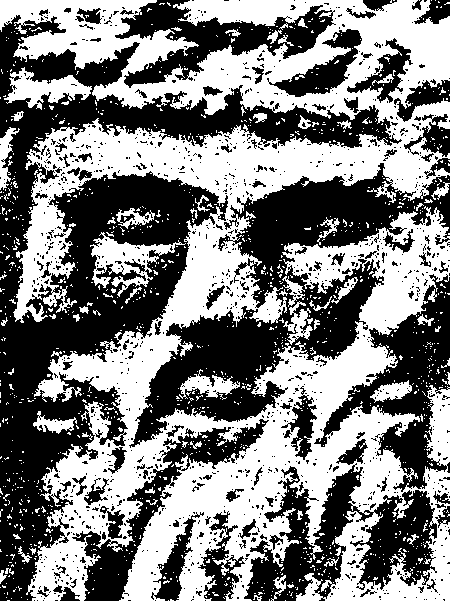
“I am the artful voyeur,” writes Heaney in Punishment, capturing what it is to encounter these artifacts. These bodies were never meant to be seen. Yet here they are, displayed for all to see. One scrutinises their intricacies like an archaeologist, half expecting an eyelid to quiver, snap open, and stare back.
It feels wrong to look. All the same, your gaze does not waver. The overhead lighting stammers out a warning, blinking in and out of life; the body seems to move, its shadow contorting between flashes. You look on, entranced.
This sense of transgression articulated by Heaney echoes lessons drawn from psychoanalysis. Like the forbidden sight of a primal scene, they transfix us, shaping the architecture of the Oedipal imagination as we take them in.
You come away knowing you have seen something forbidden, the reasons for which are more forbidden still.
Although writing about the body’s absorption into the bog itself, Heaney also reflects on our relationship to these relics.
In The Bog Queen, encased in sediment, the speaker tells us: “my body is braille.” As the bog traces the outlines of her flesh, so too do we—running our eyes over every divot and curve, every cut and tear—as though their surface might yield a language. We read the bodies as archaeologists read the earth, hoping the surface will tell a story.
Yet the bodies seem almost to mock our efforts. Our interpretations trace only the outer architecture of their form, deducing fragments about the world they inhabited.
Beneath that surface there is only absence. The inner structure has long since eroded, leaving a hollow that resists explanation. However carefully we catalogue, categorise, and date the mummified wreckage, something essential eludes us. Behind the museum glass, the Tollund Man seems almost to smirk, like one who poses a riddle.
Heaney, in his poems on these artefacts, captures in feeling what Freud describes systematically. In The Uncanny, Freud notes something “that was intended to remain secret, hidden away, and has come into the open.”
Bog bodies are liminal, existing between conventional categories. Their status is indeterminate. In gazing upon their wasted forms, one is struck by the sense that they have both arrived and never left.
Freud writes that the uncanny is something familiar that has been repressed and returns. This derives from the German unheimlich and heimlich: unhomely and homely. To encounter the uncanny is to see the familiar rendered strange. Displayed in museums, bog bodies can be observed; placards explain their origins and interpretations. It all makes sense. These bodies are, in a sense, at home, having never left the island.
For Freud, such recurrence is central to the uncanny. He illustrates this with a brief anecdote: wandering through an Italian town, he repeatedly attempts to leave a district of prostitutes, yet each path returns him to the same square. Direction scarcely matters; each attempt returns him to the same place—just as certain forms of violence recur, indifferent to time.
Like Freud’s return to the same street, the violence evoked in Heaney’s poetry echoes across time. The bodies in the bog do not remain safely buried in the past; they return as echoes in the present, resonating with a cruelty that refuses to disappear.
Displayed behind glass, illuminated by overhead lights, placards act as defence. We sanitise their intrusion upon our plane. Through the glass, one reaches in for something. But like the great elk of Bogland, once entombed in a museum, all one can clutch is “an astounding crate full of air.”
Current scholarship suggests that ancient peoples viewed bogs, like other bodies of water, as passages to another world. Deep beneath their surface lay the boundary between the world of men and one beyond.
Like time itself, “the wet centre is bottomless,” writes Heaney in Bogland. The bog functions less as a time machine than as a medium in which time is preserved in non-linear form. Composed of time, it also crystallises it.
If for Freud the uncanny is the return of the repressed, bog bodies imply something more unsettling: nothing returns because nothing leaves—violence persists, cold-stored and reissued into the present.
The ancients were, in a sense, more correct than they thought: the bodies did arrive in another world, just not as they imagined.
In modern life, we tend to imagine progress as linear—a steady path of development and refinement, events unfolding in logical succession.
To encounter a bog body disrupts that illusion. Time begins to flow both ways.
This is indeed an ancestor, part of your story. Yet what one encounters remains utterly alien, resistant to translation. Rather than travelling to the past, it comes to us, arriving as a disruption that shatters linearity.
The bog body is the moment when time breaks containment—a glitch.
Irish bogs bury traces of human violence and ritual within layers of peat.
Centuries may pass, but the bog does not destroy them—it preserves them. When bog bodies resurface, they arrive as temporal intrusions, collapsing the boundary between past and present.
Whether they realised it or not, the ancient executioners who lowered the bodies into the bog’s murky waters were inserting them into a medium capable of transporting them across time.
Encased in peat and withdrawn from decay, these bodies were effectively dispatched to the future. When the bog releases them centuries later, the message finally arrives.
The peat cutter becomes the unintentional excavator of time, engaged in a search they did not intend, but could not avoid. Every slice of the sleán brings the past to us.
These bodies were not meant to be found.