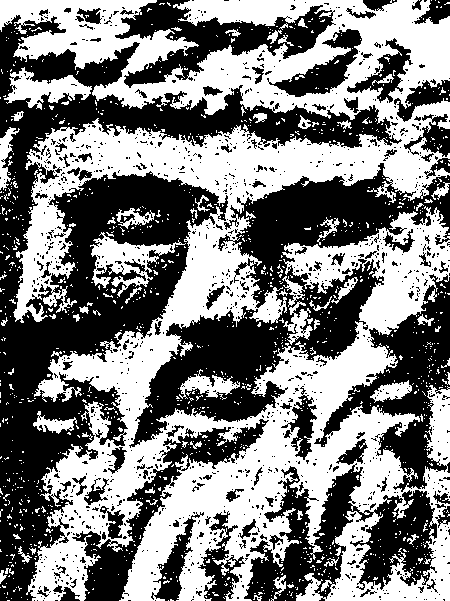
The Púca disrupts—an agent of chaos, intensifying disorder. He is neither friend nor foe, mischievous by nature. Nothing can be taken for granted with the Púca; the mistake is assuming you understand.
Traditionally appearing as a black horse, hare, dog, or goat wandering across bogs and twilight fields, it doesn’t matter who found whom. The game has already begun.
In legend, the púca may bless or ruin a farmer’s crops without distinction. He is famed for his wild rides—luring the unsuspecting onto his back, only to carry them far beyond any familiar path. He speaks in riddles, offering what sounds like wisdom in the guise of foolishness. Yet even this cannot be trusted. Whether insight hides within the joke, or the joke is all there ever was, is never made clear.
Benevolent or malicious, the Púca breaks the orderly flow of events. Comparable to Puck, to Pan, to the satyrs—he stands between anthropomorphic rationalism and animalistic ecstasy.
The Púca belongs wherever systems pretend to be stable. He does not destroy them entirely, but reveals their instability. That they were always unstable. He is anti-certainty.
Unlike other figures from Irish folklore, there is no correct manner of approach. No ritual or custom to ensure one is received graciously. All encounters with the púca are indeterminate until they are not.
This aspect of the Púca’s character is likewise reflected by his environment. He exists between farmland and wild, between rural and urban. He is encountered at crossroads—appearing as you leave the seclusion of your village, setting out upon the road.
The Púca is not a transitional point, he signals one has already crossed over. The encounter is uncanny; arriving at a destination never intended, the path bends in expectation.
And then, without quite noticing when it happened, you are no longer on the road at all. Crossing through the fields, the path worn by footfall peters out. Mountains loom in the distance, cracked and rugged like broken teeth. The wind seems to rise from nowhere. Perhaps rain is coming? Just up ahead, a black goat watches you, its head tilted slightly—as if it understands something you do not.
Today, you pass crossroads without noticing. Through field, forest, and bog, the púca is nowhere to be seen. His absence here is not a retreat, but a relocation. The Púca was never bound by territory. He was always in between.
Waves of familiar content pass beneath your thumb as you scroll. Algorithmically selected, calibrated to taste—the material registers as safe. Predictable.
A video interrupts the flow. A hornet grips a child’s arm, stinging again and again and again. There’s no context, no caption—just the insistence of it.
You scroll back up to confirm, but the feed refreshes. The video is gone. No trace of it. For a moment, it seems possible you imagined it.
Despite continual refinement, the algorithm remains unstable. Anomalous content enters the feed—not frequently, but enough. Sometimes it feels alien; other times, uncomfortably precise, as though it knows you better than you know yourself.
The Púca, however, is not confined to the digital. He can be encountered in the physical—but only in experience, never in person.
A rule is made. Enforced. Repeated.
It settles into place without being noticed.
Transgression is corrected immediately. Predictably.
Over time, the rule no longer appears as a rule. It simply is.
Then one day, it is broken.
Openly. Without hesitation.
You feel it first—a quickening, praying for interruption. For correction.
None comes.
No one reacts. Nothing adjusts.
You look again, certain you’ve misunderstood.
But there is nothing to misunderstand.
The rule is gone.
Not removed. Not replaced.
It has simply ceased to hold.
What felt fixed reveals itself as contingent, dependent on something you never saw. Memory resists this. You are certain it was otherwise. That it held.
And yet, without announcement, without transition, it has already given way—
leaving no trace of the moment it ceased to be.
An alt-coin is launched to global ridicule. Its future is an impossibility.
All the same, something takes hold. A wave of memetic energy carries its value skyward—sudden, unearned, difficult to locate in any single cause. Fortunes are made, lost, and squandered in rapid succession, all in service of a joke that no longer feels like one.
For a brief period, the value appears real. It can be measured, tracked, converted. It behaves as though it belongs within the system.
Then, just as quickly, it collapses. The price falls through itself. Liquidity vanishes. The coin disappears, fading from circulation as though it had never fully arrived.
No clear moment marks the transition. No single event explains it.
Past a certain threshold of data accumulation, truth becomes indistinguishable from its approximations. It is in this condition the Púca resides.
Even when helpful, the púca never gives what you want—only what you need, knowing you in advance of yourself.
A meme that cuts too deep, arriving before the thought it names. The Púca does not mislead you; he refuses to meet you where you think you are. You need not stray from the path. The Púca merely twists it, until you arrive where you were always going, the destination rendered only after your arrival.
You sit before your computer, the glow of the screen washing your face in blue light. A paper due in the morning. Your fingers stumble across forums, data-banks, and scattered websites, hunting for a thread to tie it all together. Hours blur. Then, in a quiet corner of Reddit, an anonymous reply catches your eye—a link to a Google Drive. You click, almost hesitantly. Inside, a labyrinth of articles, journals, and paywalled research stretches before you, all laid bare. It is everything you needed, though you never knew you were looking.
With the púca, cause need not proceed effect. The distinction between action and actor blurs, and dissolves altogether. The conclusion arrives unannounced.
You decide a course of action suddenly, without deliberation, pursuing some object for reasons unknown. Only in retrospect do the reasons assemble themselves—precise, convincing—insisting it was always your own choice. They do not feel constructed. They feel uncovered, as though they had been waiting, fully formed, just beyond reach.
There is no point at which the decision can be said to have been made. No origin to locate, no interruption to identify. Only the gradual closing of distance between where you were and where you now find yourself.
You do not recall leaving the path.
Only that you are no longer on it.
The Púca is no longer a creature you encounter, but a pattern—emerging naturally within systems as they increase in complexity. It does not destabilise these systems; it reveals that their architecture was unstable from the beginning.
Stability, order, cause and effect—these are what ground the subject. Linearity, the succession of events, structures experience into something legible, something that can be narrated.
What is most disturbing is not that the Púca pulls you from the path, but the possibility that the path had already been written—that the encounter is simply the point at which divergence becomes visible.
That the logical sequence of events is itself the aberration rather than the norm. Even if you follow the path to the end, it has always been laid in advance.
The rupture is not the anomaly—the anomaly was the sense that things held together.
You follow the path to its end, and find yourself here.
It feels, even now, like you chose it.
So, when did you?