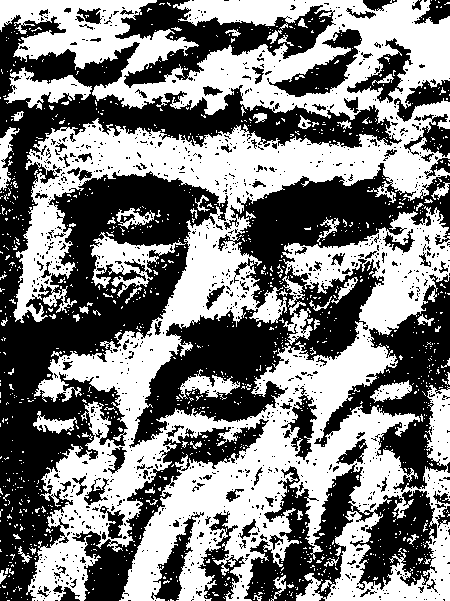
The banshee does not bring death; she signals its arrival. In rural Ireland, the banshee functioned as an early warning system, a premonition—a foretelling that death stalked the land, honing in on its target, already inscribed. When her keening was heard, villagers remained indoors. Curtains drawn. Fires dimmed. Terrified, not by the sound itself, but by the possibility she cried for them. They would not leave their homes till daylight could name the absence—who had been carried off in the night.
Yet today, her cry no longer lacerates the darkness. It no longer clings to the trees or steals across the fields. The roads are silent. It is safe to walk at night. The banshee has retreated from folklore’s theatre.
But she is more real than ever. Now, her shriek has thinned to a low infrastructural hum—the sound emanates from computer terminals, refrigerators, data centres idling at the edge of town. She no longer appears at the boundary of the family line, but is distributed across countless networks. Passing through a ghost estate—houses built for a future that never arrived—you hear it: a cry echoing through the trees. Not a threat. A notification. A silent reminder that something has already begun. The feeling passes. Looking around, the houses seem changed, uncanny—monuments to futures that stalled mid-sentence.
Death, once announced, is inevitable. The banshee’s cry does not so much commence the process; it confirms the process has already exceeded you. A famished hand reaches for the door handle that will not turn — a howl reverberates through the spine, nerves writhing in the hardware. The soup kitchen was open yesterday, closed today. Already, the machinic shriek of a computer terminal echoes as the email arrives: “rent increases effective immediately.” No need to check your bank account; you know the number before you see it. Inside the software, the screaming never stops.
The banshee signals the dissolution of the present—the shell has already dropped, the whistle was just your nervous system catching up. Awakening to the scream of a smoke alarm, the house is already engulfed in flames.
Today, she circulates through vast wireless systems, risk-assessment modules, and algorithmic sorting. As she glides effortlessly through oceans of code, she marks a passage—the inevitable. A reminder that death had been coming all along. You were just further down on the index. She does not announce; she calculates. And calculation is just a form of prophecy without mysticism.
The banshee once trailed family lineages. Today, kinships have been replaced by networks. Her cries privatized. She no longer attaches to surnames but datasets.
Why hide? The terror is no longer that she cries for you. It’s that she doesn’t. The system doesn’t care whether you hear it or not. The hum continues whether you survive or not. The email was never for you. You were a byproduct of the company that produced it.
In modernity, she becomes predictive analytics—scoring your likelihood of default, climate models projecting coastal loss, the boarded-up windows of shuttered businesses. She is the background radiation of finance capital. It’s hard to hear the screaming if the screaming never stops.
Human suffering is no longer marked. No longer registered. It is simply not in the equation. The ping of our phones only serves to tell us how alone we really are. Her wails are distorted now, broken up in the crackle of our headphones as we listen to podcasts that substitute for human connection. We hear the voices of others, but they are not ours. The death of personal connection is no longer marked with an emotional cry; it is simply part of the constant churn of data flooding our devices.
The loss her appearance signaled was once felt intimately. The absence was keenly experienced, disrupting rural communities and parishes, breaking the rhythm of everyday life. Her wail was a personal signal—a loss that fractured the family unit, that left a void.
Now, her cry is scattered across the landscape, no longer personal. She is as uprooted as the society she haunts, anonymous and fragmented. The cycling of chain businesses—open one day, closed the next—is less a loss than a data point extracted from a larger equation.
Community no longer sets. It eddies. For a moment, bodies gather—stacked in apartment blocks, queued at bus stops—then disperse again. The leases expire. The lights change. Names vanish from doorbells overnight. We haunt one another briefly, then pass through.
Once, the banshee bore witness to a community that held—her cry marking a rupture that tore through parish and kin alike. The silence she left behind was singular, unmistakable. Now, as community fragments, so too has she—no longer one voice in the night, but diffused across the circuitry, dispersed beyond recognition.
There is no wake for these closed doors; death is no longer marked as it once was. It is less a loss than a collapse of network connections. Human beings just become metrics, turnover, faceless numbers in reports.
We no longer mourn the silent estates, but the illusion that they could have been anything else. Why would the banshee cry for us, when we can hardly cry for ourselves? Your phone alerts you to a tsunami in southeast Asia, you swipe away the notification, carrying on with your day. Her shrieks pulse through its circuit boards, a piece of you dying each time. Why would you even notice?
Fully automated, the scream no longer pierces—it persists. A tone without modulation. The steady frequency of markets opening, closing, recalibrating. It hums through mortgage approvals and credit downgrades, through layoffs described as efficiencies, through projections that render entire coastlines obsolete. There is no singular death to announce because the process never pauses.
Death becomes unending. Ambient. It recedes into the background. Communities, jobs, connections—temporary. Everyone passing through. Formlessness hardens into form; layoffs and rent increases dissolve into white noise.
Though you cannot hear the screaming, it surrounds you. No icy hand upon your shoulder. Lying awake in bed, you sense something is coming—has always been coming. Sweat cools against your skin. Alone in your rented room, decisions are being finalized elsewhere. Numbers crunched. Metrics quantified. You try to stay ahead. The system was already ahead of you. You were in line all along. Your number has just been called.