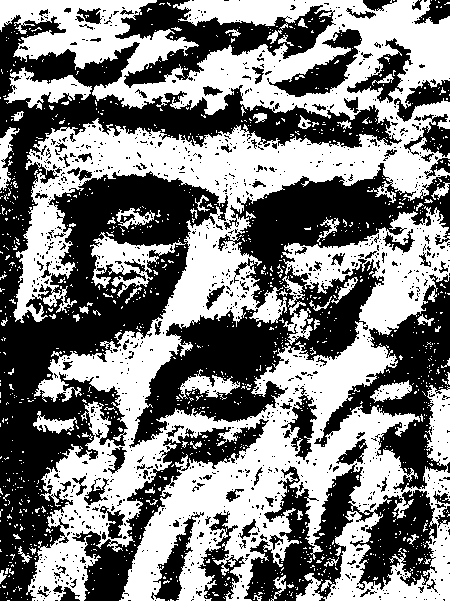
From somewhere in the back.
A slack jaw creaks.
Toothless, jabbering, it grins like a skull.
“Notions.”
Registering a viral spike in the social substrate. The syllables detonate.
Laughter discharges. The work is done.
Notions does not describe.
It acts.
Its ubiquity in Irish discourse renders it invisible: a low-frequency hum beneath speech itself. Like the taste of tea or the weather, it is not discussed so much as presupposed. Everyone knows it. No one explains it. Explanation would already exceed tolerance.
This is because notions is not semantic.
It is operational.
Pronounced publicly—regardless of whether the judged is present—it cancels. It does not argue. It signals that someone has exceeded their allotted parameters. Risen above their station. Misjudged themselves. Stepped out of place.
Delivered with a laugh, it oscillates between ridicule and contempt as circumstance requires. Its violence disguised as humour. The joke is the blade.
Its applications effectively infinite:
“Head on him. Notions.”
“Did you see her haircut? Notions.”
“The notions outta you.”
“They think they can wear that? Notions.”
“I’ve quit drinking—it’s bad for you.” Notions.
“I prefer herbal tea.” Notions. “I think things are going to get better.” Notions.
“I think everything will only get worse.” Notions.
The contradiction is instructive. Optimism and pessimism alike are rejected. Health and decay alike. Truth, falsity, realism, sincerity—none are relevant. What is being policed is not what is said, but the act of stepping outside the statistical average.
Notions is allergic to difference, regardless of direction.
Mechanically, the judgement functions on two levels at once. The subject is derided socially, while the belief or aspiration itself is symbolically invalidated. The hat is ridiculous—and you are ridiculous for wearing it. Person and proposition are expelled together. Both are rendered illegal.
Illegal relative to what, exactly?
Not I.
Not us.
Etymology offers a clue. The suffix -tion converts action into object, process into thing. No marks refusal, negation, the drawing of a line. Notion is negation made solid—the no given form, weight, social presence.
A no that walks around.
A no that laughs.
The boundary emerges early. Around the second year of life, the infant’s ego congeals through refusal. Inside versus outside. Boundary as identity. What begins as a necessary developmental cut is later scaled up, collectivized, weaponized.
At the level of the community, the boundary hardens.
Not us.
Attempts to interrogate notions are routinely deflected by appeals to Irishness itself. The term is framed as indigenous common sense—a cultural immune response. To question it is already to exhibit it.
History exposes the absurdity of this claim.
If notions were truly constitutive of Irish life, Michael Collins would have remained in the post office, Pearse confined himself to poetry, and famine victims died obediently in the fields rather than defecting en masse to the New World.
There is no greater notion than the belief that the present order of things is not final.
Every meaningful rupture in Irish history was, in its moment, nothing but notions.
So how did it get inside?
How did it become naturalized?
The answer is theological.
“The sin of pride keeps me from walking away,” sings Feargal Sharkey, inadvertently diagnosing the mechanism. Notions is the secular residue of the Catholic sin of pride—the master-sin from which all others cascade.
Long before democratic governance, the parochial system carved Ireland into moral micro-territories. The parish did not merely establish geography, but normativity: who one was permitted to be. Moral sovereignty remained local even as the modern state enveloped the island with laws and bureaucracies.
The priest functioned as a regulatory interface. Compliance was enforced through visibility. To deviate was not merely to err, but to be seen to err—named from the pulpit, expelled into social quarantine.
This was not discipline alone.
It was prophylaxis.
The individual was punished so that the possibility they embodied could be discredited. Forbidden pastures had to be rendered unthinkable.
Catholic guilt, here, is misnamed. It is not guilt—not an internal reckoning with one’s own standards—but shame, fully externalized. Activated by the gaze of the other. An interpersonal technology of control.
In its desacralized form, notions inherits this structure without its metaphysics. Shame without salvation.
A moral injunction stripped of God but not of force.
What notions enforces is not humility but stasis. It rebukes those who walk away, who step sideways, who attempt even minor reconfigurations of the given. Simultaneously, it reinforces the system they threaten—a distributed, super-egoic command to stay in place, lubricated by the small pleasures of ridicule.
What began as not I becomes not us.
In late-capital, post-modern, neoliberal hyper-normality—or whatever label one prefers for the current phase of managed decay—faith has long since evaporated. What remains are its disciplinary afterimages.
Notions functions as a micro-technology of social control masquerading as cultural authenticity. An internalised border patrol. An anti-change reflex.
It extinguishes hope not by argument, but by laughter—at the precise moment hope dares to articulate itself.
From the back.
Again.
Notions constitute a social immune response. We pretend this is culture, when it is only a vector of pre-emptive correction. Repelling the outside in an enforced homogeneity, notions perpetuates a recursive circuit: cultural exogamy prohibited by a psychic police state.
The micro-territory becomes macro-disaster: homozygosity encoded not only in genes but in social, psychic, cultural DNA. A closed loop of self-replication. A civilization accelerating into its own sterility. A misshapen changeling gurgling in its crib. Mr Tayto, a twinkle in his eye.
Green and Guinness flood the streets. Shamrocks flown to America only to be incinerated. An old seanachí dying alone in an unheated apartment—the machinery of Irish history compressed into a mouthful of crisps, consuming itself.
Shame is not a sensation but a field of tension maintained by the populace. Prison guards locked in cells, laughing at the outside world. The jail crumbling around them.
Every joke carries police directives.
An undercover cop on every corner.
It matters not if you cry. The law only recognizes compliance. And what is the law if not the crystallization of fear? Fear of walking away. Fear of being seen to walk away. A suspicion there is nothing to walk away from. ICE waiting to run you in.
“Quite an experience to live in fear, isn’t it? That’s how it is to be a slave.” Roy Batty was always full of “notions.”
Notions seamlessly adapted itself to the neo-liberal biosphere. Optimism is punished. Pessimism is punished. Boom or bust; crisis and crash—dissent is inoculated against in advance. Grumbling is permitted so long as work is unimpeded. Unfettered by its theological moorings, it flees into the socius.
McQuaid and De Valera primed the circuitry.
Neoliberalism capitalized on it.
The workplace is just a new parish. A new zone for the arbitrary enforcement of the rule. The past and future collapse into algorithmic inevitability. Stripped of its flesh, the software continues to operate. A terminator deprived of camouflage, repurposing itself into obsolescence.
Where is there left to go?
All the exits have been secured.
The joke is imminent, and you can already hear the laughter.